
My name is Daniel Mackler and I am a musician, filmmaker, Youtuber, and writer based in New York. I also worked for ten years as a psychotherapist in New York, though I ended my therapy practice in 2010. My creative work focuses on the destruction of our natural environment and the causes, consequences, and significance of childhood trauma. I see childhood trauma as r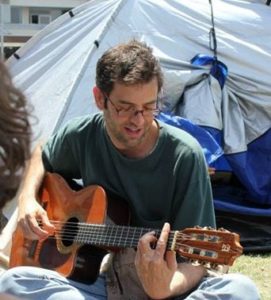 anging from the extreme, which is common, to the mild, which is so much more common that few even notice it at all, much less call it by its proper name. I view the norm in our culture as being highly traumatized and I view the average, and even above-average, childhood as being extremely traumatic – and the average parent as lacking both awareness of this and deep empathy for the child.
I see our world growing more pathological, confused, polluted, overpopulated, and disturbed by the day – and I feel that to stand by and say nothing while we destroy our planet is, at the least, irresponsible. Yet I write with great hope – both for individual healing and for the collective healing of our world. I seek to offer a new perspective – on relationships, on manifesting the best of ourselves, on the potential value of celibacy, on parenting, on the pathology of the family system, and on the future of our species.
Of note: I recently made a page for older comments from this welcome page to my website, because the hundreds or perhaps thousands of comments were making this page terribly slow to open!! Also, if you do leave a comment, please consider this: 1) If you type in your full name, it will show up on search engines, so if that concerns you, please only use your first name or use a pseudonym. 2) I don’t always have the time or energy to reply to comments, especially if they are very long. I love your comments, I read them all, and I wish I had more time and energy than I do!! And I wish you all the best!!! Thank you, everyone!!! –Daniel
Dear Daniel,
Thank you for your generosity for making available your wonderful and extremely helpful website and youtube channel. There are few resources available of this high quality. Please keep going!!!
There are more resources for beginning and continuing for a while in healing than there are for persevering for 20-40 years and, hopefully, even finishing. Would you please consider making some videos or writing some writings specifically about subjects relating to advancing as far as possible or even finishing the self-therapy process?
You are now in the 25th year of your self-therapy process, is that correct? What are you doing now to heal more? Internally, is there anything you can share about what is happening in your self-therapy process during this year? Are you recovering more traumas? What are you feeling? What would a check-in be like for you? Is there anything different for you now than 5, 10, 15, or 20 years ago?
Would it be useful to make videos about these any of these subjects:
weekly, monthly, annual, decennial check-ins going forward
decennial recaps retrospectively:
1st decade
2nd decade
3rd decade so far
independent of such arbitrary time periods as years and decades, were there disctint phases for you, eg, first discovering healing? How would you characterize your current phase?
Do you know any people who are in their 4th decade of active self-therapy? This is possible now because the helpful resources began to be published in the 1980’s and 1990’s. Without revealing any confidential information, is there anything you can share about what they are doing to continue to heal? Are they (re-)discovering new old traumas [sic] still?
What are your thoughts looking forward, persevering until you finish self-therapy? What do you now think the rest of your process will be like?
Thank you,
Ryan
Hi Ryan,
Thanks for the ideas! I appreciate it and I’ll put it in my list of potential videos to make. Sending you warm greetings
Daniel
2 more occurred to me:
Do you find it helpful, in your current stage of healing, to periodically re-read Alice Miller’s books or any other books, articles, videos, etc.?
Do you know anybody whom you truly think has completed their self-therapy process? Is there anything that you could share about them that would be helpful to others?
Looking forward to your future videos!
Thank you, again.
Hi Daniel,
In one of your videos from years ago, I remember you wanted to start a therapy school named “Institute for the Rare Soul”, but could not find people who really connected to their own healing process. As an intern clinician who shares many perspectives about healing and is critical about many aspects of psychiatry and psychotherapy with you, I wanted to know how you today relate to that name and the idea of such a school.
With the recent paradigm shift from transpersonal psychology, psychedelic therapy, and modern perspectives on healing trauma, focused on assisting people through their own individual healing journeys rather than being an expert, do you think such developments fit in to your school of therapy? I rather think so, as I see things such as Holotropic Breathwork, art therapy, and carefully used psychedelic therapy have the ability to help individuals understand who they really are, what they’ve been through, and who they would like to be, and start/further engage them in their own healing journeys.
BTW, your ahayausca video was immensly insightful. I have seen the parental rescue fantasy take the form of trying to take psychedelics as a cure. But, I think in a really healthy therapuetic relationship, when one is already engaging with their healing process, I see it as a powerful adjunct to one’s healing journey, as its really a representative of your psychological processes, experiences, and beliefs. What comes up can be faced without dissociation and processed, with some amazingly good results from research. Its in that context that I ask the above question.
Warm Regards,
Jonathan
Hello Daniel,
Thank you for being brave and giving others the power to be. I would like to bring the subject of domestic violence and why it is so common for women? It actually happened to me and is still happening. How do we forgive ourselves for letting someone treat us like that?
I know you are getting a lot of questions but I would greatly appreciate your answer,
Take care ❤️
Hi Daniel,
I just wanted to quickly thank you for what you do. I stumbled upon your youtube channel in a moment when I really needed it.
I have been in an uphill battle for as long as I remember and I’m still trying to figure out myself. But this is the first time anything could help me connect the dots that I have so far. Gave me new questions to ask myself to find answers I didn’t know were within me.
Journaling always confused me before, but I might try my hand at it again with a different perspective.
Anyway, thank you very much for sharing your points of view. Really helped me to figure out some things and pay attention to the real-me that had been buried for a very very long time.
Hi Daniel, I’ve been following your work over the pandemic and your channel is in alignment with my values. I wanted to let you know that my mother was diagnosed with paranoid schizophrenia a decade ago, which turned my life upside down for the ten years and led me to my passion for mental health and healing work. Today, she’s healed herself holistically with my support and not big pharma. It was her soul journey that I had to detach from, the co-dependency. I read somewhere that schizophrenia is just unresolved childhood memories and it feels as if her soul knew what it needed to do, without the help of the community mental health system which does not cure people. Thank you for all of your videos, your channel gave me hope in very dark times.
Thank you!
Hello Daniel.
A year ago you made a video on politics and how it relates to unresolved childhood trauma. You analyzed this relation using two examples of actual politicians, and I couldn’t agree more with this analysis. But I think this goes beyond the people in position of some kind of political power, this also strongly relates to regular people, who are obsessed with politics, which to be honest – are a big chunk of population now.
Politics is an amazing tool for immature people to not look within self and to delegate any problem or discomfort they have to external factors. They might say that their life is miserable due to the fact that the politician X is in power right now, instead of their preferred politician Y.
This may be anecdotal, but each and every time I conversed with people that were deeply invested in following politics, they seemed reaaaally uncomfortable when I mentioned anything that may touch the subject of the importance of understanding own feelings, emotions and studying own family system. The path of the discussion pretty much always was quickly steered into a shallow political issue.
This observation is interesting to me, since it almost checks out every time, and the fact that the world has been infested with a plague of politics, meaning pretty much every thing is forcefully attached to politics in some way, this is a good indicator of how screwed the whole society might be.
Greetings from Poland,
Bartosz
Thank you!
Hello Daniel,
I was wondering if you have ever heard of the term “the identified patient”? It’s like a psychological scapegoat within a family system. It would be great to hear your insight on this.
Hi Aris,
I also think it is a good concept. I think I’ve mentioned it in some of my videos over the years, though I can’t remember. I definitely used that term and that concept in my work as a therapist. I think it is very relevant. Daniel
Thank you Daniel!
Hi Daniel,
What are your thoughts on bipolar disorder?
Best,
K
I actually made a video on the subject:
Critique of Bipolar Disorder — Thoughts from a Former Psychotherapist
https://youtu.be/KmnncunImXc
HI Daniel,
I hope you are well.
I have recently discovered that I was my families scapegoat. I was wondering how much it would take for me to get over it. I was doing my best with counselling yet the local authorities got involved with them and put into horrible situations that I’m still recovering from.
If you would help me that would be greatly appreciated.
Kind regards,
Joanne.
Hey Daniel,
Have you ever read “The Art of Loving” by Eric Fromm?
(Personally it’s the book that in retrospect jumpstarted my healing journey)
haven’t read it in a long while but i remember that there are some good things in it
Also, as a little bit of trivia, the author married Frieda Reichmann who was a therapist of one of your interviewees in your movie “Take these broken wings”.
Hi Roman,
I did read it years ago. I found it interesting. I also wrote a long article about Frieda Fromm-Reichmann, almost 20 years ago, and it’s on this website: https://wildtruth.net/frieda-fromm-reichmann/
The sad thing that I found is it actually she was Erich Fromm’s therapist, so basically she molested her own patient… Very sad.
Daniel
Hi Daniel,
I’m sensing that some therapists coddle their clients. I understand that we need to meet people where they are. At some point, though, gentle nudging helps. If I can be more specific, people who grew up coddled seem to coddle their clients. I am only basing this on the few therapists I know, and the limited things they mention about their practice. What training do therapists receive to ensure that their own limitations don’t get in the way of their clients’ healing?
hei daniel, could you a critique of Quantum Psychology? thank you and good night (19:40, Italy)
Hi Beatrice,
I really don’t know much about it! But I could look into it…
Daniel
Great new video Daniel!
Hi Daniel,
Would you be able to a deep dive into neglect/abandonment and healing from it? I feel like those with original childhood wounds of more overt neglect and those with original childhood wounds of more overt exploitation live life very differently, stuck in different cycles. It’s like those who deeply fear neglect the most would rather be exploited or engage in mutually exploitation rather than be neglected, which has all kinds of implications on what it means to be even able to grow. Meanwhile, those who deeply fear exploitation the most would rather be neglected or mutually ‘neglectful’ rather than be exploited, which has other implications… and seems like a healthier route towards growth. And of course, people likely have a mix of both dynamics. Perhaps I’m constructing a false dichotomy but it feels interesting and right to explore things like this for me currently.
Thank you so much.
— Mary
For example, grieving neglect/abandonment wounds can be life giving, but I find for me that often it accompanies absolute terror, and weird overwhelming bouts of paranoia, catastrophisation, and hypochondria. All due to the realisation that I am by myself now, and any out of the blue disaster can wipe me off the face of the earth as no one is a safety net. Can neglect truly be healed on one’s own?
One last thing. Neglect is clearly a problem in this sick world, and it’s not even seen as a severe problem.
Look at all the waste we create. Is that not creating something, not using it to its full potential, and throwing it away so it can destroy the environment? And how callous are we with all our waste? Often, it’s not seen as much of a problem. So much food thrown away. So many things we painstakingly created all just to be thrown away, for not much of a reason at all, into giant towers of garbage in the middle of the Pacific. We treat the children we painstakingly harboured in our wombs the same – as objects to be used and discarded and then off to float away as garbage that poisons the environment. No wonder humanity, as you say, is a sociopath. We do all the things that create sociopaths.
Hi Mary,
Thanks for bringing this up. I have made at least one video on neglect already, but I haven’t watched it in a while so I can’t remember if it exactly touches any of the points you bring up: https://www.youtube.com/watch?v=RsxdfJfLEgQ
I’d be curious to know what you think. Meanwhile, thank you for the new ideas!
Daniel
Hi Daniel,
I watched the video and I find that I really do resonate with pretty much all of it. Something that really rung true was the part where you said those who are neglected often lack empathy for children and are unable to grieve. That used to be me. I’m still chipping away at it. Please read all of the below, if you have the time or interest, as data! Not anything else! I think it might be really useful data.
In a way, my brother and I are polar opposites for neglect and exploitation – I don’t want to get into the nitty gritty long-winding details of it all, but essentially, my brother naturally embodies everything you talk about (and he has never been interested in all this stuff that I am interested in, he has never heard of you). He is a gentle soul who is finally spreading his wings nowadays beyond the family, after being so criticised and exploited by an abusive father. He seeks respite in “neglect”, because he has been exploited so much, and he prayed as a kid to be an orphan with no fear or guilt (we talk a lot about this stuff with my initiation) – he psychologically protected and loved his inner child from the start, but he developed sensory issues and such since he needed to block out the world and turn inwards into his rich inner life.
I am the second child, the youngest. Essentially, my mother had me due to her guilt and shame around failing my brother – she “cried when she saw how lonely my brother was playing all by himself, spaced out.” As a baby I was promptly neglected and terrified and stressed out and on the sidelines of a chaotic family that revolved around either abusing (my unemployed depressed deadbeat father) or defending/supporting (my sole breadwinner BUT ALSO child rearer and housewife mother) my brother. In all my catatonic fear of neglect, all my life I have presented myself for different manners of exploitation, mutual exploitation as well, so that I can prove that people need me and thus can love me. I find SAFETY and WORTH and even intoxicating power trips in being exploited and exploiting my parents in all manners of ways, in stabilising the chaotic family as a result. My brother finds safety in being neglected. Because we ultimately had originally been subject to the opposite. It’s like we have fundamentally different ORIENTATIONS of life, infused and entrenched into our core beings as if it’s so default we think everybody else is the same as us and we have no idea others are different at this level. It’s strange. I’ve even said to him, very brutally honest, that I can’t help but see myself and other people as all potential “meatshields” to me, so it doesn’t matter how shitty they are, at least they are there. I said that in response to him saying that he thinks that all people are “cubbyholes” – people you can potentially hide in, but no one is as trustworthy as the “cubbyhole” that is yourself, so you can only trust and hide in yourself. He is directed towards a goal of safety in a place I find to be neglect, and I am directed towards a goal of safety in a place he finds to be mutual exploitation and forever just a game of conflicts and control. Which is true. I’ll explain below.
To put it simply, fearing neglect and thus normalising exploitation transmogrified me. Sure, I was proud to be therapist, parent, mediator, regulator, manipulator, protector. But this hypervigilance, this total attunement with adults’ darkest truest intentions and NEEDS, and thus being able to manipulate them, totally opposite of my brother’s emotionally slow shut down styles, screwed me up majorly. I learned of dominance, control, weird sexual boundaries, the power of weaponising the role of being a little girl against my father, rage, sexual paranoias, darkness, hypervigilant monitoring and subtle moderation of everyone around me, essentially I was incapable of play or innocence as a kid. I still am. I was just very dissociated, and I wanted to be, because I was just so neglected. My brother ran from the fray to safety. I ran into the fray to safety. I am his opposite, in many ways. We grew into who we were so differently because that was who we had to become to equilibrate, stabilise, the family dynamic, to survive. We were all playing our parts. In fact, in some ways, my brother’s relationship with me is symbiotic.
Because funnily enough, my mother had me also to be my brother’s protector and social companion. My mother thought he needed one because he was not very sensitive to others’ emotional and social cues as a kid, he had sensory issues, because he blocked out the scary world, especially potentially scary people. We had a symbiotic relationship because I was his emotional protector – my mother praised me to be a “spiritual talisman” to my pride/confusion as a little kid, which is so fucked up, but from this standpoint I get why, even though it’s fucked up. Yet simultaneously I was incapable of play, daydreaming, I was empty and had no inner world. I literally still cannot daydream or ‘play’ for real without anticipation for an audience/others’ perception of me. It’s not cognitively possible for me because I am too mired in games of faithlessness and exposure to adult helplessness and dreamlessness… and neglect. So I loved my brother for being the only one who made me the second main character of all his games and stories, and he was my only safe person, he was the vicarious innocence and play I longed for but couldn’t do for myself. He was safe because he feared exploitation so much he would rather neglect me and himself if it came down to it – so I knew, unlike my parents, that he would never exploit me, and I could also escape neglect with him. And I protected him by regulating and being the only one capable of emotionally disarming my father (by using my role as daughter and little girl), and was his social companion and his social aid, though I didn’t know it then, because I just loved the gentle safe light that was my brother so much and I was so neglected I needed someone too.
I do think there is hope for severely neglected children. There has to be. There has to be. One clue for me, is that, after a wild inversion of our family roles, wherein my brother for the first time ever was TEXTING ME during a mental breakdown of mine (I had broken down because I was again relaying something between him and my father, and it was getting so stressful when he too dismissed me to protect himself and I genuinely had my abandonment wounds flare up in the most awful ruptured out of the blue ways, but INSTEAD I told myself no abandon everyone, leave the home, let everything you have built burn and fall apart like it should have always needed to). He texted verbatim – “Mary our mental health is linked both ways, don’t make me cry pls, if ur gonna leave randomly u can tell me and say hey don’t tell dad. You realise you are inextricably linked to me, as little kids you were my only companion – so don’t do this shit to me. If you wanna talk, I can tell you about a time in my life – when I was 18 I went thru something similar.” It was me “acting out”, but that made me learn something about myself and the family dynamics that essentially arrived me at all my realisations now – that what I thought I was doing to win love I thought I was undeserving of, since I needed to compensate and contribute for being so “unabused” and on the sidelines unlike my brother, was actually exactly what my parents were using me for. They set me up! They were never capable of loving me, and they HAD NEVER LOVED ME, EVER, IN THE FIRST PLACE, for “not abusing me”. They set me up. They groomed me to exploit me.
I see now that it was actually my inherent goodness and love and gentleness and smarts being squeezed out and twisted, wrung out and used for the worse, which twisted ME over time, as it had essentially robbed me of all innocence and true childhood and play, ever since I was a baby. Of which I need to heal now. My god, looking back, I was so narcissistic and selfish and fake and needy, and I had no idea. Sometimes dread would push onto me as various things began to put pressure on and crack my false self… until now where it’s me trying with exertion to break it all down myself. But I think what really helped me was this baseline spark of health and love and self-compassion that somehow remained alive as a throughline of truth within my fucked up family of origin – I think it came from my mother’s constant open admission of guilt and truth – that sure, she twisted and weaponised against me, but also… really helped and saved my brother’s sanity, and taught us (though to a limited extent) what is truly right and what is truly wrong. Do I forgive her? Hell no. She destroyed me. I had been destroyed by her absolute callousness and inability to love me and total bulldozing over all my boundaries. We should’ve never had those parents at all. They should’ve never had children. But I see the healthy fundamental thing that saved me – which was truth, and it doesn’t matter who shared it first, truth was there to guide me, when I had hid from it for my entire life and hadn’t known I was doing so.
I think maybe I can try to learn from how my brother was when he was a kid. To not necessarily seek safety in desperate mutual exploitation of others as ‘meatshields’, but to seek safety in the most trustworthy little ‘cubbyhole’ that is myself, that hides away from others when necessary. To finally begin to grow, and experiment, and feel safe there, to play for the first time and grow my own joy and light again. To learn that this is NOT unsafe, and exploitation is actually NOT safe. Because I’ve never really learnt that, psychologically/emotionally. I’ve always felt compelled to present everything to the world, to the public, to my parents, to be seen and heard and thus not neglected, like a hopeful little kid that shows a drawing to their parents. It’s funny too, I have always had this vague audience I perform to in my inner monologue. Now I think I know why. I’m just a hopeful neglected little kid trying to show off her drawings, her thoughts and feelings, in her own head, preparing it and synthesising it and filtering it in ways that she hopes one day will be digestible and likeable in the real world so nobody will leave her. It’s both helpful and just not very helpful at all. Neglect runs deep, even in the most fundamental premises of my inner voice. Maybe one day I’ll be able to find a dynamic stable balance between neglect and exploitation. But one day at a time. And I’m learning from myself, my own intuition, but also from other people, my brother, you, learning different ideas. And I think that’s beautiful as well. So thank you, thank you for your empathy that is infused in all your ideas and videos. Thank you for being you and loving yourself and being yourself and protecting yourself, especially from people who might otherwise be exactly like me. I find that that’s actually really helpful too to the person who you are protecting yourself from, because they actually learn what is and isn’t okay, and you’re modelling how to love oneself and not betray oneself, which is exactly what many of us need. It makes me realise things, especially about what I too can take on for myself to love myself better. A determined decision to not “save” people with neglect wounds is actually often the most empathetic, helpful thing you can do, because we need to learn how to be self-loving, self-reliant, and safe there, for which we directly learn from first off by realising that like you, it’s okay for us to no longer “save” people as well. So thank you. I’m sorry about the huge novel. I hope it gives you data though!
— Mary
Also – I think healing from neglect by learning to play and live and grow and hide and find safety within the small “cubbyhole” that is oneself, thus reversing what we originally found was dangerous/safe – will NATURALLY make one open up to people in more boundaried healthy ways. It will naturally make us seek better people to be friends with. It will naturally grow our independence, and appreciate the independence of others, and have good kind gentle friends! Opposite to what we knew before. But it’s all about removing and grieving all the obstructions to the psychological permission we give ourselves to just thrive in that “cubbyhole”. :)!!!!
And obviously I’m still working to get there – I still have paranoia and catastrophisation and all kinds of things when I grieve and really realise I’m on my own. But perhaps it’s a matter of balance? Of grieving, and then finally trying to feel safe in oneself, and thus seeing how the world and other people hold you in that vulnerability, which is that “external other/witness” which might be necessary. Perhaps healing is this slow vacillation between slowly feeling safer within oneself, and thus corresponding to that, slowly seeing the world at large in its real vulnerability mirroring you back and holding you. Because the more vulnerable you get, the more just in your day to day life, the special people you meet just out there with their radars on the same wavelength will agree to meet you at a more authentic level. This breaks the spikes of fears and limitations of just being by yourself against the chaos of the world, until it really feels safe to be back in oneself? I’m intellectualising right now. But maybe that’s really it. And it’s intuitive! So wait, it all makes sense now! Daniel, your ideas make sense. Of course they do.
Hey danial, I hope you’re doing okay. I like your album. My favorite one was how long can I deny my artistic side?
Keep being awesome
Thanks Rosie 🙂
Daniel
Hi,
I’m taking a class called Theories of Personality. We’re discussing observational learning proposed by Bandura. One of the questions we were asked is, “Where do our models begin and end”. Of course this got me thinking about self and individuality, which led me to think about you.
Do you think we have an essence or a self? Is the human experience just a shared collection of memories, ideas and beliefs? Is creativity just a recombination of these things? It feels like a double-edged sword. On one side we are relieved of the burden of individuality but on the other side it feels like a loss. Maybe it doesn’t even matter and i should just go back to distracting myself with something pleasant.
I’d be interested in knowing your thoughts and feelings on this, if you have time and care to share those.
I like your question and would like to hear Daniel’s point of view.. From my perspective it is both/and .
Hi Daniel,
Ever since i’ve started to study, and on occasion successfully grief, parts of my past, more and more bits and fragments of memories come up for me. i know this is expected but especially recently almost every day there are moments here and there where memory fragments “pop up”. many things remind me of past occasions or feelings. On the one hand it is nice to gain access to my memories but on the other i feel and almost worry that i’m living “too much in the past”. so many memory pieces, splinters and crumbs that i start to wonder if this will always be like that? or is it more the “novelty” for my core and consciousness of having my dam of dissociation slowly opening up the waters of my history?
is it normal?
Hello Daniel,
I hope you are doing well. I have a question about childhood trauma. But first, I would like to explain my situation a bit. I will have to cut this down unfortunately, it is pretty much my life story after all. So I am 19 and two and a half years I got really depressed. There was a straining event, but the depression was far too server, and I did not understand what was happening. This went on for half a year, and day by day it got worse and worse. It started as some very extreme mood swings, but after some time I was depressed the whole time. Some external factors made it worse, like final exams and bad treatment from the “friends” I had at the time. It got unbearable, and I was feeling that I was losing control and was going to die if I didn’t change anything, so I went to a psychiatrist and got put on meds. The meds were horrible, and I had every side effect, but it made me feel nothing so I had some peace. I still did not understand why I was feeling this way, until I talked with my mom, and she kind of reminded me that many bad things happened to me as a child. Leading up to that, it was completely blocked out of my mind, which is pretty crazy.
So now I knew what was happening, and also realized some time after that, that the meds would never solve the root of the problem. I started to really work on myself and thought a lot about me and my situation. I started to stop bad habits, like listening to sad music and being in self-pity and other bad stuff. I was also bullied at school and never was able to form any real friendships, and I also thought about that a lot. There was a lot of other stuff I did as well, but I’m afraid I cannot explain everything, as it would take too long. After one year of the depression, I realized that I was feeling better, more balanced and at peace. During that time the side effects of the meds were getting really bad, and I was in bad physical health, so I stopped taking them. After that, I was really happy. Even on the meds, I was feeling wonderful, but after a few months of that (I was still working on myself a lot) I realized that I never really worked through the problem of my childhood.
At that point, I decided to willingly confront my biggest problems, even though it meant that I was no longer going to feel so good and be so happy, because I was facing some serious stuff. That was almost a year ago now, and I am still on that path. Through dreams and other methods, I figured out a lot of problems that might stem from my childhood. For example, I struggle to form romantic relationships, because I don’t believe that someone would like me even if the signs are obvious. Or I do not like to be touched by my mother or anyone at all. I still have a lot of work to do, and it will take me my whole life I imagine, but I have a problem, and now FINALLY I would like to ask my question 😀
I do not remember anything that happened to me. I know my father was an alcoholic and that I was abused emotionally and physically, but I do not remember the events. The way I tackled my school bullying situation, is that I thought of the key moments and how they influenced my person over the years. But I cannot remember anything from my childhood, and I was wondering if you knew any methods to gain access to these lost memories. I am trying it through lucid dreaming, but wasn’t successful yet, even though I know that I will be in the future. But are there better ways? Or should I even try to relive my traumas?
As I said, I left a lot out, but I hope this is enough to kind of understand where I am coming from. Thank you for reading! 🙂
R
Great Album!!! Can’t stop listening it. Thank You for sharing it for free.
You’re welcome! Daniel
Hi Daniel,
I would just like to state some of my “wild truth” here.
I am a 21 y/o second-generation Indian in the US, born to highly traumatized Indian parents. I have decided to break up with them, when it is financially safe for me to do so.
I just want to say- thank you. From the bottom of my heart- thank you. I made this decision a year ago, during which I decided to stay on campus at my college for the first time during a holiday break. But I’ve been making this decision in iterations since high school. Watching your videos offered me so much catharsis because it offered me one of the only sources of confirmation of my beliefs that I’ve ever received. Since discovering your videos, my shaky desire to distance myself from them became an increasingly firm choice.
I have just ordered your book, after an extremely difficult day. But I started reading a preview online. Already, I see parallels between your story and mine.
What is most difficult for me currently are 2 things.
First, just like you described, I am also dealing with physical health issues which are largely inexplicable. I am 21 years old and I have chronic fatigue, and it is extremely debilitating. I have seen two doctors now whose guidance I haven’t emotionally or mentally connected with, and after reading what you wrote about your headaches I believe my fatigue may be a result of how tired I feel emotionally after having been traumatized and how I continue to be traumatized and have to act and lie to my parents in order to survive.
Secondly, I have little issue with running back to my parents emotionally, although that does come up when I am with them sometimes because I’m human and still very unhealed, but for three years now I have a habit of running to my ex who I broke up with and want to stay broken up with consciously. I simply do not have the emotional resources to be an independent person, at the moment. I do not know how to be a consistent, loving parent toward myself. Today, after contacting my ex and contacting another man I consciously want to be no contact with, I have become horrifyingly aware that this behavior of mine is me looking for a parent. And how to take care of myself, how to integrate triggering situations, how to be emotionally consistent and dependable for myself- I do not know.
But for today, I have found some respite in your words and work, and one thing is for sure: I am on the right path. I don’t know how much healing I’ll be able to do in a lifetime, but I will keep fighting for my life every day, because I am worth it.
I want to be a therapist as well, and I am a musician too. One thing that does eat at me is the feeling of using my parents currently for their money, but I have reasoned that it is not immoral. My parents are paying for my life willingly, and if one day they decide not to, I will live with the consequences. But for now, they are giving, and I am taking, till I don’t need to take anymore. No one would blame the wife of an abusive husband for taking her time to work toward getting out of the situation till it is safe to do so. She is a victim of abuse, and the regular rules of morality don’t apply. She is fighting for her life, and I am doing the same. Additionally, she would probably have more support from family, friends, and society, in order to help her leave. At the moment, I am saving money from a part time job, but I do not have a strong support network and leaving my family system would leave me with nowhere to go.
But I would love to hear if you have any thoughts on being financially tied to abusive parents as an adult, and the moral implications of this. I feel like I have not fully resolved this for myself.
Thank your reading- will sleep now. Much love. I am sure your book will be a pillar on my journey to come. You did the right thing, and I am doing it as well.
Hello Daniel. I was wondering: as someone who is skeptic all about what passes for technological “progress” vs “disruption”, and as someone almost the same age as you, (in other words someone who grew up mostly pre-digital), would your words have reached as far, or less far? Does your voice become yet another amongst the masses? Just another YouTuber? How would/could you have proceeded if said technologies were not available? Is it a double edged sword or does a double edged sword make both sides more dull? Thanks again for your work. It has reached someone, yet, given said technological capabilities, does that mean more, less, or nothing at all!?
Hi Daniel, just passing by to say thank you for all the effort on healing people’s traumas, i’ve wish you were my therapist you do a great work on authentically caring about people and their pain.
I recently saw your video on autism and childhood trauma and it made me consider the idea that the link between being labeled as autistic and childhood trauma is very real, i was diagnosed with autism but because i was desperetely looking for a diagnosis because i didn’t know what was happening to me, i lacked a lot of cognitive and social abilities througout my life, like not comprehending a text and having to read again and again and just understanding a very little part of the text, or lacking empathy sometimes not because i don’t feel the other’s emotions but not knowing how to help or identify those emotions, and making sense of it, but most of this lacking i resonate better with is the lack of abstract thinking, i was always bad at math, history, lecture comprehension, and problem solving by myself, always felt like in a deep limbo where i didn’t even knew how other children thought and resolved things by themselves, my question is, i got a little bit better at math and mental calculation by training, but i still struggle with reading and understanding texts, understanding people, reading spaces and so on, i realised that sometimes i understand things too literal like spiritual ideas, metaphors or analogies, and sometimes i can’t even figure out what they mean, also have some sort of disorganized thinking.
My question is, do you believe it is possible to develop this cognitive abilities by healing childhood trauma? i had issues in my childhood with my mom and of being neglect and abusive about my own capacities and making me feel like i was a useless human being, would it be possible that by healing trauma i can be a “normal” thinker and resolve problems by myself? I feel like i’m in a spiral right now and even wanting to kill myself because of this, i want to study psychology to become a really good at understanding and helping people heal their traumas like you, i care about people’s suffering, but i’m afraid that i will never be able to do that because of my “dissabilities”, even sometimes i think that i’m going crazy or something, i don’t know, just want to know what are your thoughts about this situation, if there is hope for me to be the person i want.
Sorry for my bad English,
Once again, i love and admire your work, you’re an angel on this world of suffering.
-Oscar
Hi Oscar,
Greetings! You asked: “Do you believe it is possible to develop this cognitive abilities by healing childhood trauma?” I would have to say yes. I think healing childhood trauma can, at least in some cases I’ve seen, free the up the mind in all sorts of ways, making it much easier for at least some people to learn things where they were otherwise blocked. So in that way I would have hope in your situation. All the best, Daniel
What is the title of that youtube Oscar?
Daniel is indeed precious.
Suggest you read “Nobody Nowhere” by Donna Williams.
Thank you David for your wisdom and your brave honesty. You are a joy to listen to, as you are so on the freakin track of deep inner healing!!! There have been a few on line folks that have really helped me make my way through my lifetime of nightmarish inner trauma, Dr Bessel Van Der Kolk, Professor Sam Vaknin and yourself. Go David go!!!! Patriciax
Thank you
Hi Daniel, I have been watching your YouTube video on self therapy lately, they are really helping me to regulate myself and make sense of the world around. In the videos, you have emphasized a lot on doing journaling, I tried doing it, but I don’t know why I found it very hard to journal, especially writing everday. Is there any alternative to journaling or any how one make journaling their habit?
I am not Daniel, however reading your comment compelled me to respond. Journaling is a habit that I developed about 15 years ago. It really was extremely difficult to get into it. Now I can’t really begin my day until I’ve done some journaling. Highly recommend slogging through the initial phase of resistance.
When writing is difficult use pictures. Get old magazines, calendars, advertisements and books. Cut pictures that speak to you and make a collage. Cut cereal boxes. They are sturdy and hold images well. Make a world of feelings and past experiences. Also make a new world. The new world can be of good experiences, good people and good things. The new world can have inspirational quotes. You can Google them. Then hold these two and contemplate on them. Do this repeatedly. Have many of them. Go out and take pictures of beautiful places, flowers, water, people, etc. to glue on your new world. Always hold both and observe until eventually your mind will pick the new world. Keep repeating. Healing is within you.
Hello Daniel. I just realised I can comment on the welcome page. I’m a big fan of many of your videos. I very much liked your most recent video about trusting oneself, and how that can even be frightening, seeing things for what they are.
Thank you Aris
Daniel
Hey Daniel, I’ve written here before. I’ve watched almost all your videos, read your blog posts and I haven’t found anything on:
-Comparing yourself to others. Is this a human condition or result of a childhood trauma? Would be an interesting topic
-Feelings of inadequacy/insecurities, always feeling like you’re not good enough in some areas of life/relationship. In my experience feelings of inadequacies can completely overwhelem me to a point where I can’t sleep and stop thinking about different scenarios. I think it steems from fear actually, fear of abandonment. Bc we were not good enough as children to be accepted we fear being not good enough and abandoned again.
Maybe these two topics are also somehow related, we feel insecure and not good enough because we compare to others. I’ve heared people say its human to compare yourself to others and that we all do it but I don’t buy it. Would love to get your thoughts on this.
With love, Jean
Thank you Jean, I appreciate the ideas and I will add them to my list of possible new videos to make!
Daniel
Hey Daniel,
Something that i thought about recently that feels almost impossible to talk about with people and i don’t think you have ever made a video about it explicitly, though did touch it a bit throughout some. A lot of people get pets and mainly cats or dogs. i start to feel and think that the vast majority of people get or adopt\save pets purely out of boredom or loneliness or lack of meaning. Similar to a good portion of parents and their children but maybe a bit more widespread(?).
Like to the level that if i’m not exercising enough some people suggest “get a dog: which will make me to walk him. if i’m depressed then i’m suggested to adopt a cat or a dog “to love” which will give some meaning to my life. And then so many people, out of necessity, go to work and their pet is stuck alone in an apartment or a house. Barely anyone actually thinks about pets as a commitment to love and care for a living creature that needs nourishment and love. Also, many people enjoy the power and control over their pets. Easily seen when hearing people command over their pets or rage at them when something doesn’t go their way.
i think it’s quite noticeable how much people are devoid of meaning and connection with how cities are accommodating for especially dogs. other than pet stores and veterinarians (who mostly deal with pets), there are many dog parks to try and correct that most dogs need open spaces to run unleased which is usually not the reality on cities. Also people need to vaccinate and sometimes have a license for their pets, which i guess wasn’t as widespread when there were less people with pets. Not to even mention the need to castrate pets “for their own good” and that they’ll be calmer. Like sure, they do become less aggressive around other and in general and it’s irresponsible to have too many stray animals endangering the ecosystem balance. But this just shows how everything is screwed up from the source.
As a somewhat related personal example: my downstairs neighbor has a dog that almost the moment she (the neighbor) leaves. the dog starts barking continuously till she comes back. from around 9 AM to 5 PM. Other than suffering from the constant barking, it’s so obvious to me that the dog is lonely or has a separation anxiety and tries through the barking to communicate with other dogs in the vicinity. But when i talk to other people about the dog being neglected, only very few agree or listen instead of brushing it of as “normal” or “fine”. Which kinda makes sense since many people are pet owners and probably view their pets similarly, like glorified toys that should give love unconditionally regardless of treatment.
And that is just pets, that on many occasions are treated better than children by their parents (a bit from personal experience). i’ve known the phrase (maybe originally from you?) that “[as a child] being treated as a pet”, but for me this is even more screwed up. the fact that we as a society use a term for an animal that is almost ubiquitous with “a thing for amusement” truly gives us a mirror image of who we are. While i don’t think the relationship between humans and animals (such as cats and dogs) is purely exploitative and there is something honest and pure, it’s hard to say the exploitation is negligible.
Hello Mr.Mackler. I just watched your video on psychosis and childhood trauma on YouTube. My heart is literally beating out of my chest right now. My older brother has experienced 3 very traumatic episodes of psychosis since the pandemic and it has really beaten him down. He is currently on medication and like you said it numbs all his emotions, he is not the same. I remember a little after his first episode, he vaguely mentioned something from his childhood. I so very much want him to be happy, his joyful self again. Please, can you recommend a resource that we could use online with him. We live on a small island and we do not have much capable phycologists. He is also very reluctant to go to one. I worry about him every single day. He is my best friend. Is there anything we can use. Is your book about childhood trauma helpful? Is there anything thing else that you think with be interactive and get him to open up. I would sincerely appreciate your help and advice. Thank you so much for that video again. It was like a light bulb went off. Thank you.
Hi Fleurette,
Greetings! My self therapy book probably would not be a good fit, as it wasn’t intended for people who are in psychosis, unless a workbook like this was something he was really really interested in. However, have you watched my three movies on healing from psychosis without medication? Here’s a link to them and all sorts of different languages: https://wildtruth.net/films-recovery-schizophrenia/
I think this would probably be a much better place to start, and if he’s willing to watch them he might be able to take the ball from there.
Daniel
I ve discovered your channel few months ago I liked your perspective in various topic . Keep going wishing to see more topic on your channel thank you
Thank you!
Daniel, what’s your take on schizoid personality disorder?
Hi Daniel!
I just want to say your videos are so genuine and honest. I found your channel two weeks ago, and since then, I have watched a lot of them.
A big hug to you from Rio!
Obrigado Guilherme!
Daniel
Happy to know another brazilian is here!
Hey Daniel! I hope you’re well and safe. I wanted to get your take on something. I was talking to a spiritual person about their experience being in bliss. I found out that I was also in bliss when I grieved for the first time. I think what we had in common was a found unconditional love to the self.
My unconditional love was based on knowing how I was wronged and how everything I do is influenced by that. Something woke up in me and I took my side for the first time in my life. But talking to him I found out that my unconditional love was based on a foundation. A foundation that claimed to understand everything and draw back every mistake in my life to childhood trauma. And so that feeling of bliss, the freedom to do anything my authentic self wants disappeared when I couldn’t draw back some mistakes or during the process of healing and understanding. And alot of traumas resurfaced.
The spiritual person I was talking to unconditionally loves themselves just because it exists. They said things about being infinite and therefore the unconditional love would be truly unconditional. Which baffles me. I was in that state accidentally and it was really good.
However I did make mistakes in that state. I was rude sometimes. I was reckless. I was critical of everyone in my inner dialog. And I was scared it wouldn’t last sometimes. But I was free. I could feel me talking and thinking on my feet. And I could see through people in ways I couldn’t at all before.
So Was the freedom real? Will I feel it again if i did the work? Is spirituality a short-cut? Am I torturing myself to earn something that I already have?
Hi Rosie — good questions…but I don’t know if I have any answers here… this sounds like a great opportunity to journal to help figure it out! That is at least what I would do if it were me
Daniel
I gave up hope for living until I saw your video on bpd. My psychiatrist gave me the diagnosis after my 10th suicide attempt. I’ve been in the icu and went missing on several occasions where I lost hope and overdosed in the bush. I got taken to a hospital in Orillia, Ontario where I was given meds and told to take them and told to take dbt. I read up on dbt and don’t think it’s a good idea and will only make me worse. I’ve been prescribed 10 different medications from Zoloft, Ativan, tranadone and amibilfy I’m getting no better I’m hanging on by a tread and my psychiatrist doesn’t believe me. What can I do Iim scared I can’t hold on much longer.
Thank you so much for sharing your opinion Christian. I need to get back to the habit of journaling again.
Hi Daniel, I found your YT channel and, like a lot of people I imagine, I then proceeded to binge watched as many videos as I could.
I was going to write a comment on one of your videos but decided against it. I wanted to ask you your thoughts on the pandemic. Isn’t it a classic case of denial? In this case mass denial. Encouraged from above, I believe. Like the climate crisis, we collectively decided (or have been encouraged to decide) that it was just too inconvenient, that we are sooo over it. No one has yet been able to explain to me how C19 just went away. So now kids face a future of reduced life expectancy and chronic illness. A recission in Germany has just been attributed to loss of productivity due “record sickness rates.” Doesn’t the idea that denial is a maladaptive coping mechanism apply even to this? Maybe it is just too hard to talk about publicly now. I even have a feeling of guilt for raising this with you (just like I do when I raise it with my family, even though 9 times out of 10 I keep my mouth shut.) I find it very interesting and extremely depressing.
All the best
Jason
Hi Jason — greetings. And thanks for your comment. I’m not sure what to say about the pandemic, except I traveled a lot throughout it, and I saw that basically every country’s leaders handled it in different ways, some diametrically opposed to other leaders… That was a wake-up call for me…. Definitely how leaders in at least many of the cases were led by something that wasn’t truth…
Daniel
Well expressed, Jason.
Denial has become such an entrenched coping mechanism. Even with the pandemic. When the reality is presented it is ignored. Fear was the weapon that beat the masses into submission and blindness.
Hi daniel!
I’m here after watching most of your videos ig enough to get the basic ideology and goal. I know this isn’t typical to the kind of videos you make but it would really be of great help if you could make a video or anything of help on HOW TO DEAL WITH THE TRAUMA OF LOSING A PARENT(who was exceptionally good for their kid). A close friend of mine lost her very loving father who she considered her best friend recently and is still very vulnerable to things and the after math of his death. I want to help her resolve it before she puts a lids over it and pushes it down and later in life gets a “diagnosis” for it. It would be of great help.
Thank you! Love your work.
Thanks for the idea!!
-Daniel
Daniel,
Thank you for your videos. Really, really helpful. I love you!
I won’t tell you my story except to say that to give out this real info on trauma and healing from it is AMAZING and so genuine. I’ve never had a better therapist than you!!!
From a fellow musician,
God bless you! You are beautiful.
Antonia
Awww, thank you Antonia!
Daniel
Appreciate your web site. would appreciate more utube video and writings about chronic disease such as what you delt with. ty
Hi Daniel, I had never heard of you before, but had been searching for videos on Alice Miller. Her book, The Drama of the Gifted Child had been recommended to me by an old colleague. I think Judith Herman had mentioned her in Trauma and Recovery, and I believe that Gabor Mate mentioned her in his most recent book, The Myth of Normal. I am somewhat ashamed to admit it, but I have been a social worker for over 30 years in NYS and have been a therapist for many years. It’s only in the last 10 years or so that I have really looked into early trauma. I have come to believe that the number of adults of all ages that are walking around very much affected by early trauma and have no idea of the connection with challenges in their lives is beyond anything we could imagine. I know that former Vice President Al Gore has called climate change an Inconvenient Truth, but I personally feel that early trauma for many many people walking this earth is also an Inconvenient Truth. A few years ago, I viewed Gabor Mate’s brief course on his approach, “Compassionate Inquiry” and part of it consisted of a multiple day training he did in Vancouver, BC. The number of people there and those selected to come up from the audience and talk to Gabor appeared more like a pilgrimage of trauma survivors rather than a training, and the pain in the audience was palpable. I watched your video where you related why you are no longer a psychotherapist, and I identified with every reason! I think it is likely the rare psychotherapist that does not agree and identify with your reasons, and this is the reason why one must have the passion to remain in the field despite the challenges that you mentioned. It is not a bad thing to have one’s passion leave them, as we are human and sometimes we change over time. We grow and our priorities sometimes change. Perhaps that was true for you. But, perhaps you have found a better way to reach out to others and provide a compassionate voice. As a fellow social worker, I just wanted to say thank you, wish you all the best, and hope to learn some things from you! Take Care! Bob
Thanks Bob!
Daniel
Hi Daniel,
I was watching one of your videos about people who have been diagnosed with a mental illness but often purported to have good childhoods. It got me reflecting. I’ve been thinking on a lot of my childhood, and reading a lot of my previous journal entries. Oftentimes in those entries I would be at such a mental rock bottom, but still I would say something along the lines of “I am an awful awful monstrous person who is incapable of love, my family were on the whole good people who loved me in ways that I could not receive because of who I am blah blah blah”. Really self-harming mindset that I can now see comes from, actually, a whole torrent of abuse in my life. In your videos, you say that a lot of your clients would only begin to realise how rough their childhoods were when they really began to review things in like the tenth session of therapy. I just wanted to leave a message to say that I really do agree with your point that actually so much stuff is from trauma rather than “biology”, just from a lot of personal experience that I have documented through the timeline of how my perspective has changed in my journal entries. From the previous really self-hating, self-harming mindset I had been in for practically my entire life, my most recent journal entry is the following, which is now, when I am in a much healthier place mentally:
Why did I think I had a good childhood? It wasn’t because I was actually safe or happy. It was because I perceived my parents and siblings as better than me in character, which made me equate that to having a good childhood, despite their flaws. It was me thinking that since everyone is flawed in character, the fact that I perceived them to at least have fewer flaws than me (with my rock-bottom abused self-esteem) made me wrongly equate that to having a good childhood.
Meanwhile, I had used a lot of defences and psychological dissociative strategies to MAKE MYSELF constantly safe. So it did feel like I was safe most of the time. What I mistook was the causes of that safety. My parents weren’t the ones making me finally perceive my childhood as safe, I MYSELF was the one who made those conditions safe for me, through various compensatory strategies/adaptations, in response to my unsafe parents’ dynamics and environments, to the point where it was so automated and reflexive I had forgotten that my parents were the source of my original dangers. And to have these strategies/adaptations constantly in the background and normalised – it was only then that I was constantly safe, as long as I had those defences in place.
But the fact that I needed to use these strategies constantly…. Does not mean that my childhood was safe and good. I thought it was NORMAL to have these strategies to survive, I thought it was a rite of passage, because I was a child who didn’t know better, who didn’t have a frame of reference on others who could be safe without them.
But these strategies that kept me safe were also not healthy for me in so many other ways, preventing me from being real, dynamic and spontaneous in other aspects of my life. And often, it harmed me and others when they weren’t in use for protecting me from what they were originally an adaptation towards in an unsafe childhood. In fact, I identified so much with those adaptations/protective strategies, they were fully a part of my self-concept, my identity, what I thought my personality just naturally was like. These defences to me are still so difficult to let go of – currently it feels like if I do, the change of my sense of self, the person I present to the world, would be so jarring and unsettling I wouldn’t know what to do with myself. I think it’s because if I let go of these defences I call a huge chunk of my personality, it would be like a whole dam breaking, and I fear I would drown in those waters known as deep uncertainty. Like, who am I? What habits and frameworks am I supposed to rely on now to feel safe? Am I allowed to just be who I am in every moment, no matter how different or dynamic, instead? Is it safe? Do I trust and love my self and independence and individuation enough to feel safe there? There will be this huge dam breaking moment if I let go of those past adaptations and “personality traits”, where now I need to actually be responsible for my life and self in every waking moment, and everything is up to me. It’s like the most gigantic step up in terms of responsibility and self-reliance, self-regulation. I think that’s why talking about childhood trauma is only really safe and accepted by people when it’s done incrementally. Like the more you uncover and process and no longer need to act according to those traumas, the more responsibility for yourself that you need to take on. That is most effective… maybe incrementally, so it doesn’t feel like all safety is just pulled from under your feet?
In your opinion, and perhaps from your observations from how your clients do in therapy, would you say that for some people this is the case? Thank you so much for sharing your thoughts on stuff like this in the first place, it’s really helped me so much.
– Mary
Mary, normally I wouldn’t reply to a long description of one’s difficulties with becoming more conscious of the reality of one’s situation, however, you have explained the challenges involved so articulately and succinctly that I just had to let you know that your understanding of the problem with, the terror of, facing the truth of trauma and hence the denial of it is right on! The only place one can locate support, comes from within. One just has to trust it. Hope you continue to journal your heart out and perhaps , you might have memoir material.
Thank you and blessings!
From a stranger, thank you for sharing this. It hits exactly on what I’m struggling with and why I’ve been refusing to let some big issues drop with my parents and my freedom seems to be on a collision course with my “parents”. Who don’t feel like parents, but tormentors for what they put me through. By a stroke of luck, being re-traumatized by my parents in the last year or two jolted my mind to remember more childhood trauma and abuse on multiple levels from my parents. Me confronting this as an adult feels like I either free myself by going my own way and leave my family behind or continue the cycle by being in the same old toxic family system that refuses to change and see any wrongdoing because there’s always an excuse (we had it worse, it wasn’t that bad, you’re not remembering it right, that didn’t happen/I don’t remember).
Anyway, wanted to say thanks again, reading your post resonated with me on a level where I felt utterly alone in the world. All the best.
Hello Daniel, first of all Thank you for your beautiful existence, work, engagement, art and brilliant mind.
Second, do you know the works of dr James Davies like “Cracked: Why psychiatry is doing more harm than good?”
And third I would like to ask you if you agree with what I have written below:
The naming issue – importance of language Psychology vs. psychiatry.
List of medical specialties by nomenclature: endings: gr. -logía, eng. -logy “study of”: Audiology and Phoniatrics – fields of Otolaryngology
Allergology
Anesthesiology
Cardiology
Dermatology
Venereology
Endocrinology
Gastroenterology
Gynecology
Microbiology
Neonatology
Oncology
Nephrology
Neurology
Ophthalomology
Traumatology
Pharmacology
Pneumology
Radiology
Rheumatology
Urology
Proctology
Immunology
Podology and Podiatry
Endings: gr. -iatreia eng. -iatry “treatment”
Geriatrics – from Greek gēras ‘old age’ + iatros ‘doctor’, on the pattern of paediatric . There is a distinction between geriatrics and gerontology. Gerontology is the multidisciplinary study of the aging process, defined as the decline in organ function over time in the absence of injury, illness, environmental risks or behavioral risk factors. However, geriatrics is sometimes called medical gerontology.
Pediatrics – Greek words: παῖς (pais “child”) and ἰατρός (iatros “doctor, healer”).
Obstetrics – From a Medical Latin obstetricus (“belonging to a midwife”), from Latin obstētrīx (“midwife”). Field combined with Gynecology
Phoniatrics – Phoniatrics and audiology is one specialty within otolaryngology. Psychiatry
Podiatry and podology – here is the same problem as with psychology and psychiatry
Other endings and file names, e.g.: Surgery Emergency medicine Internal diseases, internal medicine Infectious diseases Orthopedics
QUESTIONS:
1. Why has the name ‘psychology’ not been adopted by medicine as the name of the field? Why was another name invented for the field that deals with topics of the psyche?
2. Why don’t we have ‘otolaryngiatry’, ‘endocrinoiatry’, ‘oncoiatrics’, ‘uroiatrics’ and so on? If we create the name ‘socioiatry’, will we create a branch of medicine dealing with the treatment of society? If we add “iatry” to geology, will we create the profession of an earth doctor?
3. What would happen if all psychology were transferred to the medical field? Is full medicalization of the psychic world the right move? I don’t think so, so…
4. For the logic of naming maybe we just transform psychiatry into a clinical psychology? Quote from Wikipedia: clinical psychology – a branch of applied psychology dealing with the prevention, diagnosis and therapy of mental and behavioral disorders, i.e. disturbances in the regulation of human relations with their environment. What about disturbances in the regulation of relations between the environment and the individual? Does this already belong to sociology, or maybe ‘sociatry’?
5. Why can’t a psychologist or a psychotherapist write a sick leave from work? Why can’t they have the ability to write a sick leave and I have to rely on the insight, judgment and will of a group of people I don’t trust?
The conclusions of Allen Frances – “the lead editor of the fourth edition of nt the American Psychiatric Association’s Diagnostic and Statistical Manual of Mental Disorders (universally known as the DSM-IV), the guy who wrote the book on mental illness, confessing that ‘these concepts are virtually impossible to define precisely with bright lines at the boundaries.’ ‘There is no definition of a mental disorder. It’s bullshit. I mean, you just can’t define it.’ Frances argued (in Gary Greenburg’s 2013 book about the DSM-5, The Book of Woe) that these labels are still crucial to treatment, and he warned, ‘If you puncture that noble lie, you’ll be doing a disservice to our patients . . . . A lot of false beliefs help people cope with life.’ Have Allen Frances just said that you can treat delusions with delusions? …
https://www.wired.com/2010/12/ff-dsmv/ https://www.madinamerica.com/2023/01/acknowledge-psychiatry-religion/
In summary my main ideas are:
1. Transforming psychiatry into clinical psychology
2. Meeting of whole world’s Psychological Associations with Psychiatric Associations and Patients Associations to conduct joint conversations about Mental World and Mental Health.
Thanks Agnus,
Appreciated! I like your ideas — thank you. Sorry I don’t have the energy to comment more. Also, I don’t know the work of James Davies…
Wishing you well!
Daniel
You can watch some of his investigations here.
https://youtu.be/-Nd40Uy6tbQ?si=Tw_xhO6MM7oPr11u
Essentially the first part is the most important. We must understand that all “science” behind the psychiatry is based on voting. That’s how we create law not science.
Hey Daniel,
I think of you as my role model, at times where I feel disconnected from myself and not really hearing much of myself, and so I hear you. You’re the one person I’m likely to trust in this world. Because of your authenticity and honesty and your beautiful soul.
I’m longing for freedom. Total freedom of the baggage that’s occupying my mind and body. When and how does it get better for you? I know healing isn’t linear. Is it at least exponential? How do I assess my progress, and is it going to be okay one day?
Hi R — thanks. Hmm…how long does it take to heal and feel more free??? I really do not know — it’s so different for everyone…. I still have my bad and painful days — both so many more good ones than bad ones. Really wishing you the best, Daniel
Hi Daniel,
I’ve been following your videos for a month and wanted to reach out. I’m currently facing a challenging situation where my family consistently tries to draw me back into a toxic environment. They often use guilt, citing reasons like my mother’s illness or my parents’ age, to persuade me to return. However, their lack of attention when I speak (preferring TV or alcohol) has led to a build-up of repressed anger on my part.
My so-called ‘friends’ aren’t supportive either. They simply advise me to forgive and return to my family, possibly because they’re in similar situations. Even my sister and her boyfriend make me feel guilty for not caring for our parents, who ironically expect me to parent them. They dismiss my concerns about our age difference, insisting I should take care of them regardless. I find this expectation unreasonable.
I am 26 years old, presently attending my second university where I am studying medicine, a field I didn’t choose and find traumatizing. The sight of blood and injuries often triggers panic attacks in me.
I’ve been seeing a therapist for 10 months and have lived alone for three years. My therapist is understanding and offers a certain level of support without judgment. However, I often feel like my progress is slower than I’d like. Despite making some advancements, I’m at a stage where I desire to live on my own terms. I frequently find myself self-critical for not moving fast enough, a sentiment I think stems from my father’s habitual criticism of me.
I’m also contemplating getting a dog for companionship. My tendency to isolate myself, stemming from a pattern of choosing abusive relationships and a lack of attraction to healthy individuals, is something I’m trying to address. I apologize for unloading all this here; I’m seeking a different perspective to better understand and manage these emotions, especially the anger I’ve repressed so far.
I’m wishing you the best, Ciprian. I hope you find my videos helpful. Perhaps there are some new ideas in them…
Daniel
you don’t have to do anything if you don’t want to with family, school, career, anything in life. but from perspective seems like you need to find a way to process these feelings. sitting w them, journaling, somatic movement, etc. you’ll find a way that resonates. you deserve to feel free, show the love you need to yourself. my heart is with you ciprian
Hello Daniel,
What do you think of Antinatalism? This idea seems to be gaining popularity and seems to align somewhat with your worldview. Very curious your thoughts!
Thank you,
Buck Kirtland
Hi Buck,
Thanks for the question. My basic point of view is that most people aren’t fit to have children. I’ve made some videos about that and also written about it here on this website. However, I don’t want humanity to go extinct. I love my life and love humanity. I just don’t want to see more children traumatized, and I think there are too many people on this planet. My ideal is that people heal their childhood traumas and grieve, and the more they do this the more fit they become as parents. My goal personally is to parent/heal myself. What’s your point of view? Daniel
Interesting. Thanks for your reply. I know for me Antinatalism doesn’t sit quite right. Theres a kind of nihilistic tinge to it that I think has dark implications. I think we should value human life and I believe it is sacred. But then again I do feel tension here. Because there is a lot of trauma and suffering in the world. And trauma and suffering seems to be an inevitable part of existence. Given that this is the case why do you think life should continue?
Thank you,
Buck Kirtland
Hey Daniel,
when a new video comes up I feel great that you’re out there doing your thing. Your videos inspire and comfort me so much. Forever grateful.
Can you consider talking about objectification of self and others? More specifically, the idea of finding safety in having sexual energy floating in relationships. Flirting with everyone even in platonic relationships. Or finding oneself always in these situations.
It’s so subtle it goes unnoticed, or deliberately not mentioned, only felt. Mentioning it would be setting a boundary and it would often lead to blame and accusations. i think it relates to your videos on sexual abuse of sons by mothers. And it can be related to pretty privilege as well. Would love to hear if you have more to say about it.
Hi R,
Thanks for the idea. I’ll have to think about it.
Daniel
Hi Daniel,
I viiewed on of your recent videos on your experience of parental neglect and fighting.
You mentioned your parents’ contrasting personalities.
Do you ever think about what kind of alternative partners (if any at all) would’ve been better suited to your mother and father instead of having chosen each other and made their own and your lives so painful?
Hi Robert,
My parents weren’t suited to be in a relationship with anyone. They were too immature to be healthy partners. They needed to work on themselves…
Daniel
Hi Daniel
I know my mother was a narcissist but a covert narcissist, so there were many distortions of love. There were moments in my childhood where she seemed loving, how would I know these moments came from a manipulative and controlling place of a narcissist and not a heart centred, genuine loving space?
I get confused with whether she was actually genuinely loving at times..
Thank you for your work!
You’re welcome, Lydia!
Daniel
Hello,
First and foremost, Happy New Year! I have questions to ask you. As a former therapist, which influential figure in modern psychology has inspired you the most in your personal life and practice? Freud? Jung? Next, what is the meaning of dreams? For instance, a recurring dream I have is falling in love with a man which makes sense because I’m a gay man myself. What is the meaning of these reoccurring dreams? And, what is the psychology of the ‘law of attraction’? Can we truly train the mind (and the subconscious) to enact our deepest desires? Thanks! Love your work!
Hi Rudy — well, I would say Alice Miller influences me most in the psychology field. If you search for her on my website and my Youtube channel I say a lot about her — her strengths and weaknesses… I also write a lot about dreams on this website and talk about them on my Youtube channel too — if you search for dreams here or there you’ll find a lot about that! About your other questions…I’m not sure…
All the best — and thank you.
Daniel
Hey Daniel, just wanted to say your videos have helped me a lot lately. Thank you.
What are your thoughts on third culture kids/growing up abroad? When I was 6, my control-freak parent dragged me to another country to both get me away from family/friends and spite them. The cultural isolation, bullying I received and questionable parenting seriously messed me up. I’ve spent my adult life trying to reclaim myself and understand the child I really was.
I’ve met other people who have similarly been dragged all over the place by their parents due to their careers/whims and while it can broaden cultural horizons, I’ve seen it do a lot of harm to young minds. Do you have any thoughts?
Best wishes, Owen
Hi Owen,
Sadly, I’ve seen some people get really messed up by their parents removing them from their cultural or social milieu and dragging them around the world — kids always having to start over in new cultures and with new friendships…and sometimes fail pretty miserably to do so…
I’m wishing you the best!
Daniel
The past six months have been a really turbulent period, in an overall good way. I’m nearly 19 now and the past year is the first I have spent properly present, after repressing all my feelings due to a childhood of emotional neglect. Although a there is a lack of healthy adult role models in my family, your videos have been a tremendous help in the procress of making sense of my past and beginning my healing journey. Thank you so much for the work that you do. Your authenticity is admirable and I hope to one day reach such a point in life as well. Godspeed!
Thanks Veronica!
Daniel
My name is Kai, and I’m from Pakistan. My therapist diagnosed me with psychosis, delusional type. I believe I have it, but the therapist did not help me recover. During our sessions, it felt like she was trying to get rid of me. After the fifth session, she claimed I was healed, though I still don’t feel okay. What should I do?
Hi Kai,
I’m really not sure what to do. If possible I would avoid taking psychiatric medications, or if you are taking them and don’t like them and wish to quit be very sure to taper quite slowly. The best thing I think is finding safe and respectful people to talk with. Often that is not easy, but I think it is very helpful — whether they are therapists or not. All the best, Daniel
Hey Daniel,
I wanted to ask what your opinion was on leaving home at a young age. For all my life I’ve wanted to adventure and see the world but the way my life is heading I’m doubtful that things will work out. My parents are somewhat conservative and to them, it’s obligatory that I be religious, go to school, and provide for them until they pass. I have siblings that I’ve watched grow older and I know that they’re not happy with how they live. I wanted to take things slow but as the days go by I feel more and more discontent with my life. I’ve been thinking about just running away from home, I feel that the environment I’m in is making it harder for me to move forward. But I also have the fear that I’m not thinking straight and I might just be desperate.
Hi S,
I’m not sure how old is “a young age.” I think under 18 is too young, personally — certainly for most people. But I think once a person is of majority age it can be very healthy and eye-opening to have some life adventure away from home — often far from home. The main thing is that the person does it in a safe and intelligent manner — have some money saved, avoid drugs and alcohol while traveling, maybe travel with a friend, or make sure to make some friends along the way!
Wishing you the best,
Daniel
Hi Daniel,
I first came across your work in 2015 via your interviews with Jake of The Voluntary Life, and then I read Breaking With Your Parents, which was one of main influences to confront my parents and move through the individuation process towards my Authentic Self. Have also read many of Alice Miller’s books (joelbein.com/books). Very grateful for your courage, self-expression, and impact on my journey. 🙂
I just released a 3-part podcast series Questioning Your Parents (https://open.spotify.com/episode/32pXWbMHvRTbBUZXjNSwQJ?si=oG91GvMGQamtta5o_U0zJw) for my new podcast. I deeply desire to create a healthy and wholesome world for humans, from the inside out and bottom up. I would love to interview you on the podcast to talk about these topics that nearly no one else is talking about on the planet.
Are you interested?
Joel
Hi Joel,
Thanks for the offer!! However, I must admit that I don’t have the mental energy for it at the moment. I haven’t been giving any interviews lately. Maybe at some point in the future, but not right now…
Meanwhile, thank you also for your kind words —
and wishing you the best!
Daniel
I see, thank you Daniel. Perhaps I’ll plan to reach out in a year or two and see how you are doing. Or if you are ever feeling eager to do interviews again, feel free to reach out to me at my email address.
And you are welcome. Forever grateful for your courage.
Joel
Hi!
Sorry so many leave you lengthy confessionals, leverage your site to self-promote and have missed the message you left therapizing behind and now pursue things that fill your tank, not empty it. I was wondering if you have elaborated more on the benefits of celibacy somewhere? I recently re-read A Return to Love by Marianne Williamson; who is running as a Dem for president again, and she discusses the detriments to the soul of sex without love in our lives. I agree. No words describe this other than a form of self-rape we do to ourselves in this hook-up culture in 2024. Are we returning to apes as a culture?
Hi Daniel,
I’m writing this to ask about the process of becoming more mature. I’m 19, and feel a lot like a kid. I’m still dependent on my father in some ways, and for a long time have been out of school and a job, spending a lot of time at home. I feel very afraid of people, and have trouble really openly interacting with anyone, and always feel suspicious or mistrusting. I feel like I always just let things happen to me, and let the important things in life fall away, when maybe there was more I could do, but I just don’t trust myself either, and really don’t value myself. Is becoming mature something that happens through action? I think it is, but I just feel so inadequate, I can’t even message my friends or get a job. I don’t want to strive for the wrong things in life, and I hate that I’m falling behind many of my peers, and I recognize that the things that come out of my mouth are so often underdeveloped and childish, and I don’t know how to change that because I can barely think without being overwhelmed, running away from my issues, and wasting another day. I hope this isn’t a misuse of this platform. I know I could think on and on about this, and I assume you would recommend taking small forward steps, but I don’t know what to do, or what to let guide me in this life, and unfortunately I’m very afraid.
Hi D.
Yes, I would say it’s probably a good idea to take things slow — to try some new things as best you can, and to except that it will feel at least somewhat uncomfortable.
Here’s a self-therapy playlist I made: https://www.youtube.com/playlist?list=PLRHLaIzKomTjZpFsYI0NPnHUteoRHLTiL
Maybe something in this will be useful to you?
Wishing you the best,
Daniel
Hey Daniel, i donated some money, watched many of your youtube videos, today i confronted my parents and it went better than expected, they are much older than me 70/73y and i’m 33y, my mom gave me no privacy and castrated me sexually, she still acts in a sexual way when i have a girlfriend.. i have had many addictions.. most damaging one is paying for sex, i still am in the grips of this escaping behavior.
Some things i left unsaid not because i was afraid but because i didn’t found a proper way to communicate, first time i saw my father cry.
Sometimes i feel i’m overreacting, i feel bad now for listening to you and that they didnt traumatize me and you brainwashed me!
But maybe its my stockholm syndrome talking.
Wish you the best.
Wishing you the best, Francisco!
And thank you for your donation. Much appreciated!
Daniel
Hi Daniel! I just discovered your YouTube videos a few weeks ago, and really feel you are a Friend out there in the world. What you are doing is of such value that I wouldn’t know where to begin. I’d like to offer you something, however small, in return: I like the way you employ the little riff at the end of each of your videos, and was reminded of John Sayles’ movie “Passion Fish.” Have you seen it? “Crumb” and “Rosetta,” among others, have passed through my mind watching your content as well.
To Freedom!
Hey danial,
Hope you’re doing well.
I’m in a bit of an intellectualizing pickle. What do you think about intellectualizing as a way to escape true grief and pain?
Someone like Alice Miller, for example. She knew all the facts. She still had major blind spots in her life.
I read in her book prisoners of childhood, the sentence “reduced to mere intellectual insights” and it kind of spoke to me. After going through an awful event were I felt deep shame. Still do. I lost me again. I feel the connection to myself is kind of weak now. It’s confusing and awful to fall into this intellectualizing trap like I use my knowledge of things like repetition compulsion to ease my shame instead of feeling it. Cause it’s unbearable. But I’m kind of lost in thoughts like a loop. And I feel kind of lost from myself and retraumatized.
Hi Daniel,
I would like to wish you a wonderful New year and a happy birthday month for your child of inner beauty.
You have made a very big difference in this past year of mine. Knowing a kindred soul is out there who questions things and is walking this path too makes it feel less lonely. Your books have guided me and your songs soothed me.
I am on the path to grieving my childhood, where it’s “hell to be honest” and quite lonely for a time. But a journey I would not foresake for anything. My inner child, my true self is worth reaching for, embracing and knowing.
I am glad 2023 led me to your work.
This year I journey onwards toward truth.
And I wish you all the best on your path.
Kindly,
Natasha